
26 for 2026 Initiative: Do you have an Ocean Conservation event but need a venue sponsor? Submit your event to host Solar-Powered Community & Sustainable MICE Events in Singapore and let OPP help!

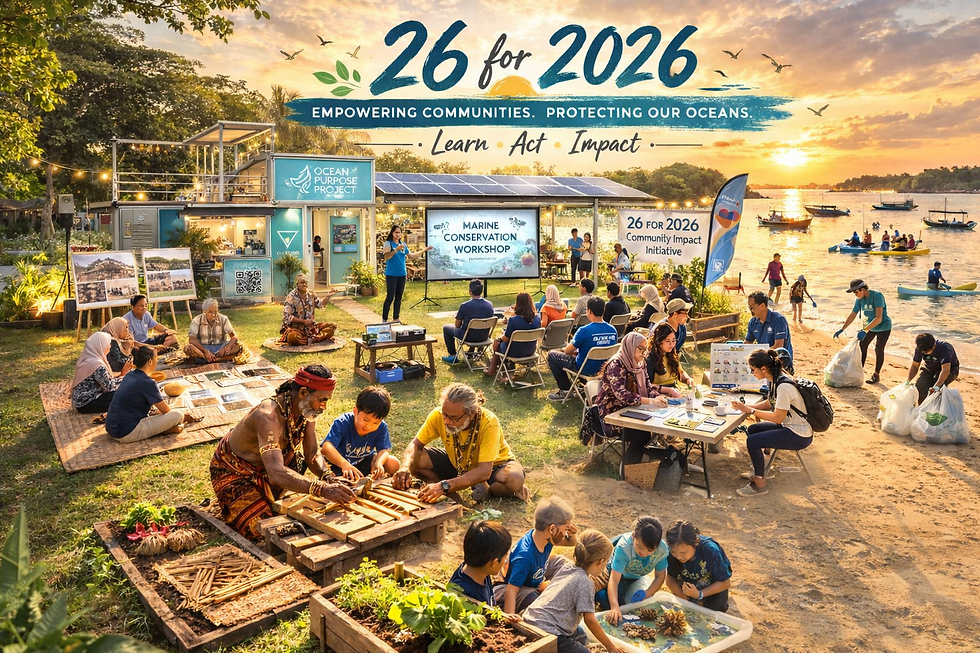
Ocean conservation. Marine pollution prevention. Indigenous coastal storytelling. Blue economy education. Preservation of Singapore's coastal heritage. All these are worthy causes but with rising costs, it is getting very difficult to find free spaces that are powered sustainably, by the beach in tranquil settings and easily accessible.
At Ocean Purpose Project (OPP), we believe real change does not only come from global summits or policy declarations. It comes from sincere, grounded, community-led action.
The Ocean Purpose Project’s “26 for 2026” initiative offers a unique opportunity to support 26 community-led projects that focus on ocean conservation, marine pollution prevention, Indigenous coastal storytelling, and blue economy education. This program provides sponsorship for venue use and refreshments to projects that demonstrate clear environmental benefits and long-term outcomes.
This blog explores how the 26 for 2026 initiative works, what kinds of projects qualify, and how you can get involved to make a real difference for our oceans.

🌊 What Is the 26 for 2026 Initiative?
The 26 for 2026 Initiative is OPP’s pledge to support 26 sincere and well-designed community projects between now and 2026.
Selected projects will receive:
Venue sponsorship (valued at $1,000–$2,000 per event)
Light bites and drinks
Access to up to 20 kWh of off-grid solar energy
Fans, lights and a projector screen
Basic Wi-Fi for talks or hybrid engagement
Access to our eco-herb garden and coastal setting
Charging facilities for participants
Optional discounted SUP boards for marine research or coastal education
We are prepared to forgo our usual rental fees — but only for projects that demonstrate sincere, genuine community value, environmental depth and long-term outcomes.
This is not a sponsorship for performative sustainability. Definitely not a sponsorship for those looking to hide corporate objectives behind freebies, make a quick buck or score volunteering points.
This is for projects that mean something. Projects thats truly care.
Criteria for Project Sponsorship
Not every project qualifies for the 26 for 2026 sponsorship. The Ocean Purpose Project looks for initiatives that:
Have clear environmental impact with measurable results.
Show depth in their approach, not just one-off events.
Demonstrate long-term outcomes that contribute to ongoing ocean or coastal community health.
Integrate marine ecosystem education to raise awareness and knowledge.
Link activities to longer-term environmental pathways, such as policy change or community stewardship.
🌞 A Fully Solar-Powered Coastal Event Space in Singapore
Our OPP Beach Office at Pasir Ris is one of the few fully off-grid, solar-powered event spaces in Singapore. Our previous solar panels were rescued from Pulau Semakau and have been upgraded. Powered by high-quality solar panels and battery storage systems supported by Jumbo Bee and Modular Tech, our venue generates approximately 20 kWh per day, allowing the equivalent power consumption of:
10 laptops (50W for 8 hours)
2 air-conditioners (1,500W for 10 hours)
1 mini fridge
7 LED lights
3 projectors
Outdoor fans and lighting
Device charging stations
Machines that turn humidity into water for our plants
We are not offsetting carbon.
We are not connected to the grid.
Your event electricity is powered directly by the sun.
🚆 Travel Green to Our Sustainable Event Space
Hosting a sustainable event in Singapore begins before delegates arrive.
Participants can:
Take the MRT to Pasir Ris Station (EW1)
Board Bus 403
Alight at Pasir Ris Beach, Car Park E
Walk a few minutes to our beach office
No private transfers required. No unnecessary emissions.
Clean public transport connects city to coastline seamlessly.
🌱 Who Should Apply?

The 26 for 2026 initiative is intentionally inclusive.
We welcome applications from:
Religious communities hosting stewardship dialogues by the sea
Youth groups organising sustainability panels
Elderly groups sharing intergenerational coastal stories
Schools and universities running marine ecology workshops
Indigenous community groups sharing traditional ecological knowledge
NGOs exploring governance, social equity or coastal livelihoods
Blue economy student groups presenting sustainable aquaculture solutions
Social enterprises piloting community education programmes

Your project does not have to be purely scientific.
But it must meaningfully connect to:
Ocean conservation
Marine pollution prevention
Coastal community resilience
Indigenous coastal storytelling
Blue economy education
Environmental governance and stewardship
If it strengthens coastal consciousness, we want to hear from you.
🌊 A Hybrid Indoor-Outdoor Community Experience
Our space offers:
🌿 Air-conditioned indoor room (up to 10 pax)
🌊 Outdoor coastal event space (40–50 pax)
🌞 Hybrid indoor-outdoor programming
🌿 Access to eco-herb garden
🎥 Projector & solar lighting
🔌 Charging stations
Imagine:
Students sitting on grass discussing marine policy
A mindfulness circle powered entirely by solar
A blue economy hackathon by the shoreline
A governance roundtable overlooking mangroves
A university research workshop integrating SUP-based coastal sampling
Sustainability here is not decoration.
It is infrastructure.
How Community Projects Can Maximize Impact
To qualify and maximize the benefits of the 26 for 2026 initiative, community projects should consider the following steps:

1. Incorporate Marine Ecosystem Education
Teaching participants about the local marine environment, species affected by pollution, and the importance of conservation creates a deeper connection. This education encourages ongoing stewardship beyond the event itself.
2. Connect to Long-Term Environmental Goals
Projects should link their activities to broader environmental pathways. This might include:
Partnering with local governments to improve waste management.
Collaborating with schools to integrate ocean education into curricula.
Supporting Indigenous-led conservation efforts that protect traditional territories.
Examples of Potential Projects

Here are some examples of projects that fit the 26 for 2026 initiative’s goals:
An Indigenous group hosts storytelling sessions sharing traditional knowledge about sustainable fishing and coastal stewardship.
A local school runs a blue economy program teaching students about sustainable aquaculture and marine resource management.
A nonprofit develops a campaign to reduce single-use plastics in coastal towns, backed by data collected from community clean-ups.
Each of these projects combines action, education, and long-term vision to protect ocean health.
🎯 OPP’s 26 for 2026 Assessment Framework

To ensure integrity and impact, every proposal will undergo a structured internal evaluation by the OPP team.
We assess based on five pillars:
1️⃣ Impact Depth (30%)
We evaluate:
Clear environmental or social outcomes
Measurable metrics (participants, data collected, behavioural shifts)
Defined learning objectives
Tangible conservation relevance
Strong proposals answer:
What will change because this event happened?
How will we measure that change?
2️⃣ Long-Term Pathways (25%)
We prioritise projects that:
Connect to policy conversations
Integrate with schools or institutions
Build recurring programming
Strengthen governance or community leadership
Extend beyond a one-day activation
We do not fund one-off optics.
We fund catalytic interventions.
3️⃣ Community Authenticity (20%)
We assess:
Sincerity of intent
Grassroots leadership
Inclusion of underrepresented voices
Indigenous or intergenerational knowledge transfer
This is not for corporate checkbox CSR.
This is for genuine community activation.
4️⃣ Data & Accountability (15%)
Where applicable:
Education programmes must define knowledge outcomes.
Dialogues must outline behavioural commitments.
All selected projects must submit a one-page impact report including:
Offline and online reach
Learning objectives achieved
Environmental or social results
Evidence of renewed commitment to stewardship
We measure consciousness — not vanity metrics.
5️⃣ Sustainability of Operations (10%)
We evaluate:
Low-waste event planning
Digital materials over paper
BYO bottle initiatives
Responsible catering
Thoughtful energy use
The event should embody sustainability — not just talk about it.
📊 Post-Event Reporting Requirements
All 26 sponsored projects must submit:
Total participants engaged (offline + online)
Social media reach
Learning outcomes achieved
Waste data (if applicable)
Behavioural or mindset shifts observed
Long-term commitments catalysed
We ask one fundamental question:
Did this project spark something real?
🌍 Why Community-Led Ocean Conservation Matters
Communities are the first to witness:
Eroding shorelines
Polluted beaches
Declining biodiversity
Cultural displacement
Disconnected youth
They also carry:
Traditional ecological knowledge
Intergenerational wisdom
Local accountability
Long-term presence
When empowered with space, infrastructure and belief — transformation happens.
How to Apply and Get Involved
If you lead or know of a community project that fits the criteria, the next step is to reach out to the Ocean Purpose Project. When applying, be ready to provide:
A clear description of your project and its goals.
How your project will measure environmental and social impact.
Plans for education or community engagement.
Details on how the project links to long-term ocean conservation.
Even if your project is still in the planning phase, the initiative encourages early conversations to explore eligibility and support.
Why Community-Led Ocean Conservation Matters
Local communities are often the first to witness the effects of ocean pollution and habitat loss. They also have unique knowledge and motivation to protect their coastal environments. Supporting community projects builds capacity, raises awareness, and creates a network of ocean stewards.
The 26 for 2026 initiative recognizes that small, well-structured projects can lead to significant change when supported properly. By sponsoring venue costs and refreshments, the initiative removes barriers so communities can focus on meaningful conservation work.
✨ Sincerity Over Scale
Let us be clear.
We are not looking for:
Greenwashing.
Performative panels.
One-day PR exercises.
We are looking for:
Youth with courage.
Elders with stories.
Students with ideas.
Faith groups reflecting on stewardship.
Communities building coastal resilience.
🌏 A Sustainable MICE Alternative in Singapore
Beyond community projects, our solar-powered coastal venue also offers an alternative for:
Sustainable MICE events
ESG leadership retreats
Climate innovation workshops
Coastal governance roundtables
University marine research symposia
When your:
Lights
Projector
Air conditioning
Charging stations
are powered by solar energy,
your sustainability narrative becomes lived reality.
📝 How to Apply for 26 for 2026
Email partnerships@oceanpurposeproject.com and send us:
A clear project description
Defined learning objectives
Intended environmental or community impact
Measurement methodology
Long-term vision
Alignment with coastal or ocean stewardship
Even if your idea is still forming — start the conversation.
We would rather co-develop a strong idea than review a polished but shallow proposal.
🌊 26 Projects. Real Impact. One Coastline at a Time.
The ocean does not need more awareness campaigns.
It needs communities who:
Gather intentionally
Measure impact
Act consistently
Lead with sincerity
Through 26 for 2026, Ocean Purpose Project is placing our space, solar infrastructure and support behind those ready to build that future.
If that is you —
Come by MRT. Take Bus 403. Walk toward the sea, turn left and meet us at the OPP Beach Hub.
And let the sun power your next meaningful activation. 🌞🌊


This write up worked well because it organized the thoughts in a clean way and kept the overall feel clean and straightforward. It kept my attention in a simple way.
slot thailand
The article felt easier to enjoy because the clear direction was direct and useful. It was pleasant to read and stayed useful.
super33 link
The explanation had a well arranged quality that made the article feel focused and pleasant. It felt nicely arranged with a friendly touch. Yamaha 2.5hp Outboard for sale